Buy dragons-shop.com ?
We are moving the project
dragons-shop.com .
Are you interested in purchasing the domain
dragons-shop.com ?
domain@kv-gmbh.de · 0541-91531010
Buy dragons-shop.com ?
How would our world look like if there were really dragons?
If dragons were real, our world would be a very different place. We would have to coexist with these powerful and mythical creatures, which would likely have a significant impact on our environment, ecosystems, and even our societies. There would be new challenges and opportunities as we navigate a world where dragons are a part of our reality, and we would have to find ways to live alongside them while also respecting their power and autonomy. It would certainly be an awe-inspiring and potentially dangerous world, but one filled with wonder and mystery. **
How would our world and our society look?
If everyone in our world and society were to practice empathy, understanding, and compassion, our world would be a much more harmonious and peaceful place. There would be a greater sense of unity and cooperation, leading to less conflict and division. People would be more willing to help and support one another, leading to a more equitable and just society. Overall, the world would be a more empathetic and caring place for all its inhabitants. **

Similar search terms for Usborne-Beginners-Our-World
Top-Angebote
Products related to Usborne-Beginners-Our-World:
-
The Dinosaur Book: Our World in Pictures (DK Our World in Pictures)Find out everything you need to know about dinosaurs, pterosaurs, marine reptiles, and prehistoric mammals with this picture-packed encyclopedia of curiosities. Come face-to-face with some of the most incredible creatures ever to exist in this incredible book of dinosaurs and other prehistoric life. With more than 1,000 extraordinary images and fascinating facts, kids aged 9-12 will love poring over the pages of Our World in Pictures: The Dinosaurs Book. This book brings to life all forms of prehistoric creatures through vivid illustrations and realistic digital reconstructions, showing their fearsome teeth, tails, legs and scales that enabled them to eat, move and defend themselves against predators. Celebrate your child's curiosity as they explore: - Striking and detailed diagrams, drawings, and illustrations on every page. - Covers all forms of prehistoric life, from the first primitive invertebrates to dazzling dinosaurs, and the earliest mammals. - Up-to-date, essential information about dinosaurs' evolution and extinction, and every aspect of dinosaur science. - Picture-heavy and text-light approach to introduce geological periods, evolution and extinction, and every aspect of dinosaur science. Young readers will love to find out about the latest scientific discoveries that have changed the way we see these fascinating prehistoric animals - from the discovery of feathered dinosaurs to analysing what has been found in their stomachs. Find all this and more in this dinosaur encyclopedia, featuring at-a-glance panels that provide a quick reference to all the stats, making it an ideal combination of colourful diagrams and informative text boxes. The easy-to-read text is accessible for kids aged 9+, yet can be enjoyed by the entire family, making this enthralling children's encyclopedia a beautiful and educational gift that can be passed down generations. Learn all about the world one picture at a time!7,95 £*Shipping: 2,99 £Secure redirect to the provider

-
Does it make physical sense in our world for dragons to exist?
In our world, it does not make physical sense for dragons to exist as they are typically depicted in mythology and fantasy. The large, flying, fire-breathing creatures described in stories would not be able to be supported by our planet's ecosystem and would likely violate the laws of physics. However, if dragons were reimagined as more realistic creatures, such as large reptiles or birds with unique abilities, it could be possible for them to exist within the constraints of our world. **
-
Is our world actually impossible?
Our world is not impossible, as it exists and functions in reality. While there are certainly challenges and problems that may seem insurmountable at times, humanity has shown an incredible ability to adapt, innovate, and overcome obstacles. The world may be complex and difficult, but it is not impossible. With collaboration, creativity, and determination, we can continue to make progress and improve the world we live in. **
-
Why does our world exist?
The existence of our world can be attributed to a combination of scientific and philosophical factors. From a scientific perspective, the world exists due to the formation of the universe through the Big Bang and the subsequent evolution of galaxies, stars, and planets. From a philosophical standpoint, the existence of our world may be seen as a result of complex interactions of physical laws, chance events, and the emergence of life. Ultimately, the question of why our world exists may be beyond our complete understanding, and it may be a fundamental mystery of existence. **
-
Is our Earth a world or a divided world?
Our Earth can be seen as both a world and a divided world. It is a world in the sense that it is a planet that sustains life and provides a habitat for a diverse range of species. However, it is also a divided world in terms of the social, political, and environmental divisions that exist among its inhabitants. These divisions can be seen in issues such as inequality, conflict, and environmental degradation, highlighting the challenges we face in creating a more unified and sustainable world. **
Is there infinity in our world?
Infinity is a concept that exists in mathematics and theoretical physics, but it is not directly observable in our physical world. While we can conceptualize infinity in terms of numbers, space, and time, there is no concrete evidence to suggest that infinity exists as a tangible reality in our world. Our universe is finite and bound by physical laws, so the idea of infinity remains more of a theoretical construct than a physical reality. **
Has our world arisen by chance?
The question of whether our world has arisen by chance is a complex and debated topic. Some believe that the intricate design and complexity of the universe suggest a higher power or intelligent design, while others argue that the laws of physics and natural selection can explain the development of our world without the need for a guiding force. Ultimately, the answer to this question may depend on one's personal beliefs and perspective on the origins of the universe. **
Top-Angebote
Products related to Usborne-Beginners-Our-World:
-
Usborne Beginners Our World Series 10 Books Collection Box Set (Planet Earth, Weather, Trees, Under the Sea, Volcanoes)Beautifully illustrated stories which engage children and start their love of reading. These amazingly constructed stories use the worldly featured as a tool to help with your children reading at an early age. Recommended Reading Age 7+ years Titles In This Set: Seasons Trees Antarctica Rubbish & Recycling Weather Earthquakes & Tsunamis Volcanoes Rainforests Under the Sea Planet Earth Related Tags: seasons explained,four seasons for kids,changing seasons,spring summer autumn winter,activities by season,what causes seasons,learning about seasons,types of trees,tree life cycle,importance of trees,forest trees,parts of a tree,planting trees,kids books on trees,antarctica facts,antarctic animals,antarctica exploration,climate in antarctica,antarctic research,life in antarctica,antarctica for kids,recycling for kids,what is recycling,waste management,reduce reuse recycle,rubbish sorting,environmental recycling,recycling facts,types of weather,daily weather changes,weather forecast basics,weather for kids,extreme weather,learning about weather,weather instruments,earthquake facts,what causes tsunamis,natural disasters earthquakes,tsunami safety,earthquake preparedness,seismic activity,earthquakes for students,types of volcanoes,volcano eruptions,active volcanoes,volcano facts for kids,how volcanoes form,volcano models,volcanic activity,rainforest animals,amazon rainforest facts,deforestation rainforest,rainforest layers,tropical rainforest,rainforest habitats,rainforest resources,ocean animals,life under the sea,deep sea creatures,ocean habitats,undersea exploration,marine life facts,sea plants and animals,planet earth facts,facts about earth,earth science,earth layers,save the planet,earth and environment,planet earth resources14,99 £*Shipping: 2,99 £Secure redirect to the provider
-
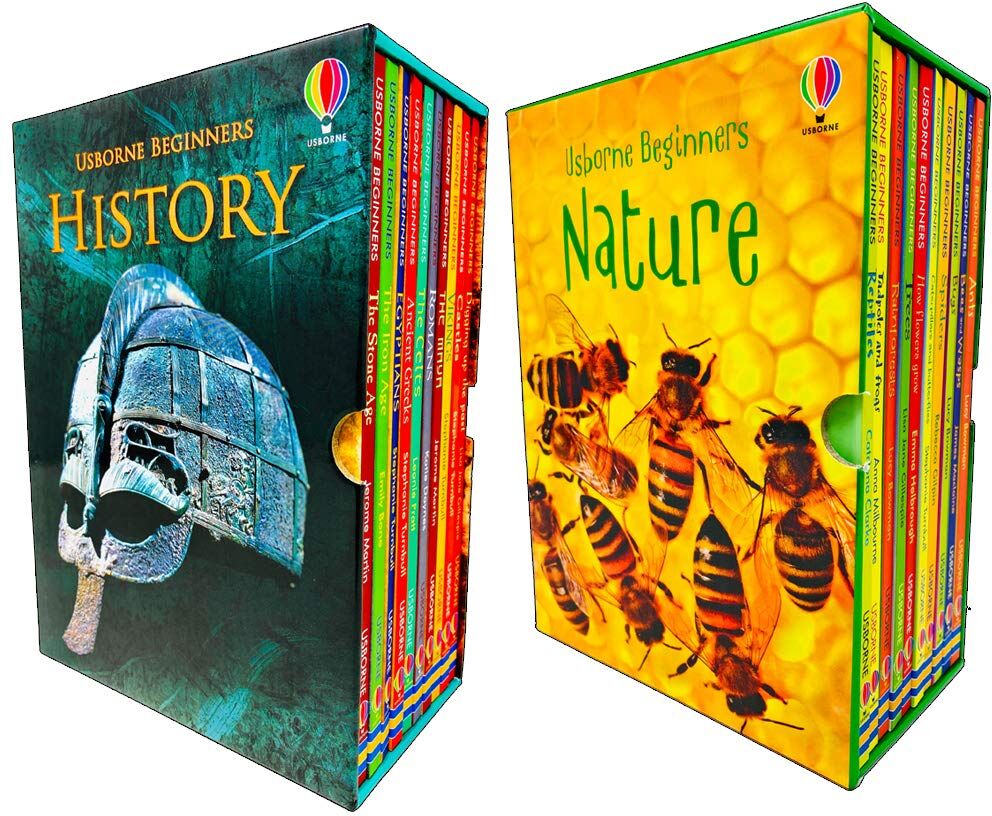
Usborne Publishing Ltd Usborne Beginners History & Usborne Beginners Nature 20 Books Collection Box SetTitles in this set: Usborne Beginners History Stone Age Iron Age Egyptians Ancient Greeks Celts Romans The Maya Vikings Castles Digging Up the Past. Usborne Beginners Nature Reptiles Tadpoles and Frogs Rainforest Trees How Flowers Grow Caterpillars and Butterflies Spiders Bugs Bees & Wasps Ants Description Stone Age This simple information book follows the history of Stone Age people and how they lived. Iron Age This simple information book charts the history of Iron Age people and how they lived, including their farming methods, the gods they prayed to and the hill forts where they lived. Egyptians Who were the ancient Egyptians? Why did they build pyramids and how were mummies made? Ancient Greeks Find out about Ancient Greece, what people wore, ate and did for fun and learn about some of the most famous philosophers and mathematicians of the age in this compelling book for beginner readers. Celts Who were the Celts exactly? Did you know they lived on top of hills? Do you have any idea how Celtic warriors made themselves look really scary in battle? Romans Who were the ancient Romans? Where did they go to eat, shop and wash? What did they do for fun? The Maya Who were the Maya? Where did they live? Why did they build tall stone temples? Vikings Find out what it was like to be a Viking, and learn about Viking homes, feasts, boats, gods and much more in this fascinating book. Castles Who lived in a castle, and what was it like? Children can find out the answers to these questions and lots more about the wonderful world of castles in this informative book. Digging Up the Past How do ancient things get buried? Who digs them up? And what do they find? Beginner readers can find answers to these questions and more in this colourful information book. Reptiles This is a fantastic brand new addition to the "Beginners" series, designed to provide an informative introduction to trees and plant-life for young readers. Tadpoles and Frogs Vivid, full colour illustrations and photographs on every page, accompanied by short, informative text. Rainforest It offers a terrific reading practice for children who prefer fact to fiction. It is developed with a reading expert from Roehampton University to help young readers grow in confidence. Trees This is a fantastic brand new addition to the 'Beginners' series, designed to provide an informative introduction to trees and plant-life for young readers. How Flowers Grow How do flowers grow in dry deserts? How do animals help to spread seeds? Which flower smells like rottng meat? Caterpillars and Butterflies Usborne Beginners are colourful information books for children beginning to read on their own. Spiders Usborne Beginners are colourful information books for children beginning to read on their own. Bugs Usborne Beginners are colourful information books for children beginning to read on their own. Bees & Wasps A slim and unintimidating book which belies its contents - a wealth of information, much of which will be...34,99 £*Shipping: 2,99 £Secure redirect to the provider
-
The Dinosaur Book: Our World in Pictures (DK Our World in Pictures)Find out everything you need to know about dinosaurs, pterosaurs, marine reptiles, and prehistoric mammals with this picture-packed encyclopedia of curiosities. Come face-to-face with some of the most incredible creatures ever to exist in this incredible book of dinosaurs and other prehistoric life. With more than 1,000 extraordinary images and fascinating facts, kids aged 9-12 will love poring over the pages of Our World in Pictures: The Dinosaurs Book. This book brings to life all forms of prehistoric creatures through vivid illustrations and realistic digital reconstructions, showing their fearsome teeth, tails, legs and scales that enabled them to eat, move and defend themselves against predators. Celebrate your child's curiosity as they explore: - Striking and detailed diagrams, drawings, and illustrations on every page. - Covers all forms of prehistoric life, from the first primitive invertebrates to dazzling dinosaurs, and the earliest mammals. - Up-to-date, essential information about dinosaurs' evolution and extinction, and every aspect of dinosaur science. - Picture-heavy and text-light approach to introduce geological periods, evolution and extinction, and every aspect of dinosaur science. Young readers will love to find out about the latest scientific discoveries that have changed the way we see these fascinating prehistoric animals - from the discovery of feathered dinosaurs to analysing what has been found in their stomachs. Find all this and more in this dinosaur encyclopedia, featuring at-a-glance panels that provide a quick reference to all the stats, making it an ideal combination of colourful diagrams and informative text boxes. The easy-to-read text is accessible for kids aged 9+, yet can be enjoyed by the entire family, making this enthralling children's encyclopedia a beautiful and educational gift that can be passed down generations. Learn all about the world one picture at a time!7,95 £*Shipping: 2,99 £Secure redirect to the provider
-
How would our world look like if there were really dragons?
If dragons were real, our world would be a very different place. We would have to coexist with these powerful and mythical creatures, which would likely have a significant impact on our environment, ecosystems, and even our societies. There would be new challenges and opportunities as we navigate a world where dragons are a part of our reality, and we would have to find ways to live alongside them while also respecting their power and autonomy. It would certainly be an awe-inspiring and potentially dangerous world, but one filled with wonder and mystery. **
-
How would our world and our society look?
If everyone in our world and society were to practice empathy, understanding, and compassion, our world would be a much more harmonious and peaceful place. There would be a greater sense of unity and cooperation, leading to less conflict and division. People would be more willing to help and support one another, leading to a more equitable and just society. Overall, the world would be a more empathetic and caring place for all its inhabitants. **
-
Does it make physical sense in our world for dragons to exist?
In our world, it does not make physical sense for dragons to exist as they are typically depicted in mythology and fantasy. The large, flying, fire-breathing creatures described in stories would not be able to be supported by our planet's ecosystem and would likely violate the laws of physics. However, if dragons were reimagined as more realistic creatures, such as large reptiles or birds with unique abilities, it could be possible for them to exist within the constraints of our world. **
-
Is our world actually impossible?
Our world is not impossible, as it exists and functions in reality. While there are certainly challenges and problems that may seem insurmountable at times, humanity has shown an incredible ability to adapt, innovate, and overcome obstacles. The world may be complex and difficult, but it is not impossible. With collaboration, creativity, and determination, we can continue to make progress and improve the world we live in. **
Similar search terms for Usborne-Beginners-Our-World
-
Why does our world exist?
The existence of our world can be attributed to a combination of scientific and philosophical factors. From a scientific perspective, the world exists due to the formation of the universe through the Big Bang and the subsequent evolution of galaxies, stars, and planets. From a philosophical standpoint, the existence of our world may be seen as a result of complex interactions of physical laws, chance events, and the emergence of life. Ultimately, the question of why our world exists may be beyond our complete understanding, and it may be a fundamental mystery of existence. **
-
Is our Earth a world or a divided world?
Our Earth can be seen as both a world and a divided world. It is a world in the sense that it is a planet that sustains life and provides a habitat for a diverse range of species. However, it is also a divided world in terms of the social, political, and environmental divisions that exist among its inhabitants. These divisions can be seen in issues such as inequality, conflict, and environmental degradation, highlighting the challenges we face in creating a more unified and sustainable world. **
-
Is there infinity in our world?
Infinity is a concept that exists in mathematics and theoretical physics, but it is not directly observable in our physical world. While we can conceptualize infinity in terms of numbers, space, and time, there is no concrete evidence to suggest that infinity exists as a tangible reality in our world. Our universe is finite and bound by physical laws, so the idea of infinity remains more of a theoretical construct than a physical reality. **
-
Has our world arisen by chance?
The question of whether our world has arisen by chance is a complex and debated topic. Some believe that the intricate design and complexity of the universe suggest a higher power or intelligent design, while others argue that the laws of physics and natural selection can explain the development of our world without the need for a guiding force. Ultimately, the answer to this question may depend on one's personal beliefs and perspective on the origins of the universe. **
* All prices are inclusive of VAT and, if applicable, plus shipping costs. The offer information is based on the details provided by the respective shop and is updated through automated processes. Real-time updates do not occur, so deviations can occur in individual cases. ** Note: Parts of this content were created by AI.